Checklist for Good Practice
Responsible land ownership in Scotland


Key principles
If you own, manage or advise on the management of significant areas of land in Scotland, you can use the information below to independently evaluate your current practice. Our Good Practice Team offers advice and support for those who want to develop and/or demonstrate leadership in good practice.
Principles of responsible land ownership are set out in the Scottish Government’s Land Rights and Responsibilities Statement and associated protocols issued by the Scottish Land Commission. The protocols were developed in consultation with the Good Practice Advisory Group and Community Benefits Advisory Group, and offer practical advice on how land owners, land managers and communities can work together to make better and fairer decisions about land use. Practical application of the protocols is expected to be proportionate and reasonable.
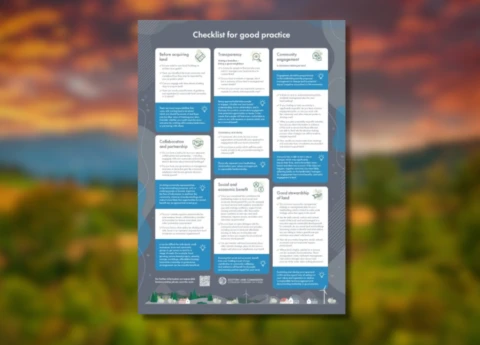
Checklist for Good Practice
If you would like to contact the Good Practice Team please email goodpractice@landcommission.gov.scot or call 01463 423 300.
-
- Do you need to own land/buildings to achieve your goals?
- Have you identified the local community and considered how they may be impacted by your acquisition plan?
- Can you engage with them ahead of taking steps to acquire land?
- Have you made yourself aware of guidance and regulation for responsible land ownership in Scotland?
There are many responsibilities that come with owning land in Scotland which you should be aware of and there may be other ways of meeting your aims. Consider whether you could meet the same outcomes by working with existing landowners or partnering with others.
Helpful resources:
Protocol on opportunities for ownership, lease and use of land and buildings
-
Setting a baseline – being a good neighbour
- Is it easy for people to find out who owns and/or manages your land and how to contact them?
- Do you have a website or signage which has a summary of how land is managed and contact details?
- How do you ensure you respond to queries or requests in a timely and reasonable way?
Being approachable helps people to engage. It builds trust and mutual understanding, forms relationships, and is the basis for positive, constructive engagement over potential opportunities or issues. It also means that people will feel more comfortable to come to you with requests or queries which may be to mutual benefit.
Consistency and clarity
- Is everyone who works for you or your organisation on board with your approach to engagement with your local community?
- Do you have a policy which staff are made aware of and/or do you provide training for relevant staff?
Those who represent your landholding should reflect your values and approach to responsible landownership.
-
Engagement should be proportionate to the landholding and the proposed management or change and its potential impact (negative or positive) on the community.
- Is there an easy to understand and publicly available management plan for your land holding?
- If your holding or land use activity is significantly impactful, do you have a formal engagement plan, or can you work with the community and other relevant parties to develop one?
- When you plan potentially impactful activities, how do you share information in advance of the work to ensure that those affected are able to feed into the decision-making process when changes can still be made to mitigate impacts?
- How would you ensure notes from meetings and outcomes from consultation are recorded and shared in good time?
Everyone has a right to know about changes which may impact their lives, and to have their views heard and taken into account. If this does not happen, negative outcomes are more likely, reflecting badly on the landholder/manager. So, engagement has mutual benefits, and early engagement is best!
Helpful resources:
Protocol on community engagement
Community engagement in decisions relating to land (Route map)
Developing an engagement plan for decisions relating to land (Practice Guide)
Information about communities - A Guide for Landowners (Information map/ infographic)
-
- Do you have a policy for how you approach collaboration and partnership – including engaging with your community and involving them in decisions about land and buildings?
- Do you have any governance or management structures in place that give the community, employees and tenants genuine decision-making power?
Involving community representatives in decision-making processes, such as working groups or boards, helps the flow of information to and from the community, minimise misunderstandings and make it more likely that opportunities for mutual benefit are recognised and acted upon.
- Do you routinely appraise opportunities for joint ventures, leases, collaboration, transfers of ownership (or shared ownership), and other partnership approaches?
- Do you have a clear policy for dealing with sale, lease or co-operation requests from local businesses or community organisations?
It can be difficult for individuals, small businesses, trusts and community groups to get access to land for a range of needs (for example: food growing, nature-based projects, amenity, storage, workshops, affordable housing). Innovative ownership or governance arrangements can be mutually beneficial.
Helpful resources:
Protocol on opportunities for ownership, lease and use of land and buildings
Protocol on community engagement
Community engagement in decisions relating to land (Route map)
-
- How do you and your land holding contribute to local economic and social development?
- Do you have an open dialogue with the community about local needs and priorities, including access to land and affordable housing, to help you to articulate and agree on how you support local social and economic development?
- Do you have an open dialogue with the community about local needs, including access to land and affordable housing, so you can explicitly agree the ways in which you will support local social and economic development?
- Are you familiar with local community plans, other relevant strategic plans for the area or region and plans your neighbours may have?
Ensuring that social and economic benefit from your holding is part of your (or your organisation’s) contribution to community wellbeing and resilience will benefit local people and increase positive regard for your work.
Helpful resources:
-
- Do you have a proactive management strategy or management plan for your landholding, which is linked to wider scale strategic plans that apply to the area?
- Are the built, natural, carbon and cultural assets of the land used and managed in a way that supports sustainable development? For example: how do you avoid land and buildings becoming vacant or derelict and what actions are you taking to reduce greenhouse gas emissions associated with land-use?
- How do you review long-term social, cultural, economic and environmental impacts of decisions?
- Where land is highly suitable for a primary use (for example: food production, flood management, water catchment management, and carbon storage), how do you take account of this value when making decisions?
Evaluating and sharing your approach to this can be a good way of setting out your values and aspirations in relation to responsible land management and demonstrating leadership in good practice.
Helpful resources:


STAY CONNECTED
Get the latest news, research and events from the Scottish Land Commission direct to your inbox