Research and Reports

Understanding the impact of re-introducing rates for shooting and deer forestry

14-page PDF | 0.75 MB
Understanding the impact of re introducing rates for shooting and deer forestry

Authored by:
Alma Economics

Published:
4 August, 2026

Policy theme:
Land use and the environment, The land economy

4. Valuation roll and tax

4.1 Entries and overall rateable value


Using the valuation roll, it is possible to examine the scale of the tax base created by the removal of the exemption. The analysis below includes all entries listed on the valuation roll for non-domestic rates with a core description of shooting. The data was downloaded on the 2nd of February 2026 and reflects the most recent completed revaluation cycle of April 2023.

As of 2nd February 2026, there were 11,280 listings. Non-domestic rates relief statistics for 2025 reporting 11,278 listings as of 1st of June 2025. SPICe undertook a similar analysis in Spring 2023, identifying 11,327 listings, and the SBBS evaluation reported 11,732 listings as of 1st January 2020. Taken together, these figures indicate relative stability in the number of entries over the past few years. However, a more comprehensive trend analysis extending back to the original inclusion of sporting entries on the valuation roll would be required to assess this more definitively.

The overall rateable value is publicly reported. As of the 1st of June 2025, the total rateable value was approximately £13.5 million. This is broadly consistent with the £13.9 million total rateable value estimated by SPICe in 2023 and illustrates the overall scale of the tax base following the reintroduction of rating for shootings and deer forests.

Applying the poundage rate of 0.498 implies an estimated potential gross revenue of £6.7 million, before accounting for reliefs. This provides the basis for assessing realised revenue and the interaction with relief schemes, particularly the SBBS.

4.2 Interaction with the Small Business Bonus Scheme


The SBBS offers a reduction on a property’s non-domestic rates bill where the rateable value is below £20,000.

For ratepayers with a single property:

  • Where the rateable value is up to £12,000, 100% relief applies.
  • Between £12,001 and £15,000, relief tapers from 100% to 25%.
  • Between £15,001 and £20,000, relief tapers from 25% to 0%.

For ratepayers with multiple properties:

  • 100% relief applies where the combined rateable value is up to £12,000.
  • Where the combined value is between £12,000 and £35,000, relief is 25% for properties with an individual rateable value of £15,000 or less, tapering to 0% for properties between £15,001 and £20,000.

These reliefs apply to all eligible non-domestic properties and are not specific to shooting estates.

Further examination of the valuation roll shows that entries for shooting are heavily concentrated at the lower end of the rateable value distribution, with almost all properties up to the £12,000 threshold for 100% relief.

This contrasts with the wider non-domestic property base in Scotland. The 2022 independent evaluation of the SBBS found that just over three quarters of non-domestic properties associated with single-property businesses fell below £15,000, which was the threshold for 100% relief under the scheme at the time, and the latest figures from the Scottish Government show that 49% of all non-domestic properties received a 100% relief. Shooting entries are therefore more heavily skewed toward low rateable values than the wider non-domestic property base.

Rateable ValueNumber of Shooting Estates% of All Shooting Estates
< £12,00111,21799.4%
£12,001 – £15,000350.3%
£15,001 – £20,000150.1%
> £20,000130.1%
Total11,280100%

Table 1: Alma Economics analysis of the valuation roll

As the table shows, as of February 2026, 99.4% of shooting estates have a rateable value below £12,000. If each were held as a single property by an individual ratepayer, they would be eligible for 100% relief. A further 50 estates (0.4%) fall between £12,001 and £20,000 and would be eligible for partial relief under SBBS, again assuming single-property ownership. Only 13 properties exceed £20,000 in rateable value and would therefore receive no SBBS relief.

Actual relief depends on ownership structure and whether relief is claimed. The SBBS evaluation also showed that take-up among eligible properties is relatively high.

4.3 Reliefs and estimated net revenue


Non-domestic rates relief statistics for 2025 (as of 1st June 2025) report that approximately £4.5 million of relief was provided to shooting properties, of which £3.6 million related to the SBBS. Comparing this with the estimated gross liability of £6.7 million, we can estimate that annual net income was £2.2 million (£6.7m minus £4.5m).

Of the 11,278 listed properties as of June 2025, 8,890 properties received some sort of relief, with 8,600 receiving 100% relief, further illustrating the narrow effective tax base once reliefs are applied. Given that the number of listings has changed only marginally since that date, it is reasonable to expect that current revenue levels remain similar.

It should be noted, however, that overall revenue needs to be inferred from gross liability and reported relief. In addition, to the best of our knowledge, time-series data is not published, which limits the ability to assess the fiscal impact.

For comparison, a Parliamentary Question response reported that in 2021 22, shooting rights and deer forests raised £1.7 million in non-domestic rates income and received £4.9 million in reliefs. That figure was based on the 2017 valuation roll rather than the 2023 revaluation, which may account for some of the difference in reported totals.

4.4 Distribution and threshold effects


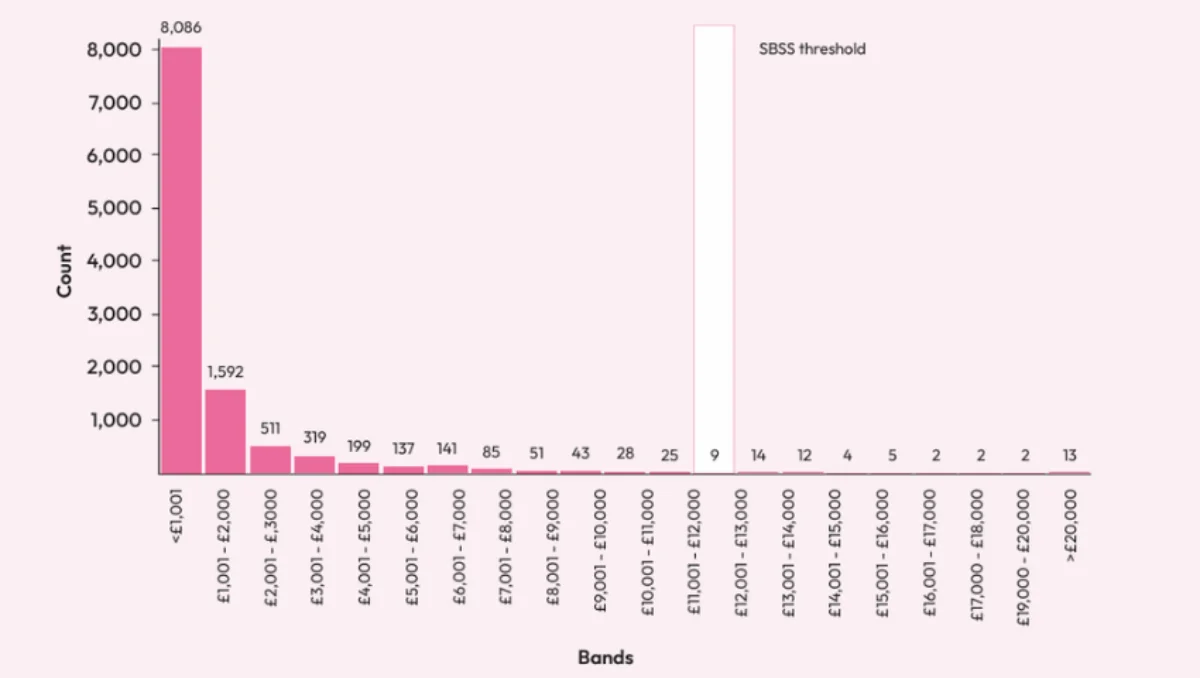
As Figure 1 shows, entries for shootings on the valuation roll are highly skewed towards very low rateable values. Of 11,280 entries, 99.4% are below £12,000. Indeed, 72% are below £1,000 and 86% below £2,000. The tax base is therefore dominated numerically by very small entries.

Figure 1: Shooting estates by rateable value compared to the threshold

Out of the total, only 63 properties have a rateable value above £12,000, and just 13 of these exceed the £20,000 threshold at which tapering of relief ends.

These 63 entries are geographically concentrated. Twenty-five are located in Highland and the Western Isles, and a further 20 in Tayside. The median rateable value among them is £14,700, with a maximum of £28,250. In terms of classification, they are split broadly evenly between deer forests and shooting rights.

Ownership concentration also affects relief eligibility. In its 2023 analysis, SPICe grouped properties with identical proprietor names to approximate multiple ownership. Very large landowners – including Forestry and Land Scotland, Buccleuch Estates, Scottish Ministers, and the Crown Estate – were identified as exceeding the £35,000 ceiling for SBBS eligibility. These large owners accounted for around 600 property listings and were assumed to receive no SBBS relief.

Beyond these, just over 1,000 ratepayers were identified as holding multiple shooting estates. In most cases, their combined rateable value still remained below the £12,000 threshold for 100% relief. Only 63 multiple owners exceeded £12,000 in combined rateable value, and for these, SPICe assumed 25% relief under SBBS.

Taken together, this evidence suggests that while the majority of shooting properties generate little or no net liability after reliefs, net revenue is likely to be concentrated among a relatively small number of larger or multi property ratepayers.

Threshold effects

Given the design of SBBS, it is useful to look closely at properties with rateable values just below and just above the £12,000 threshold. In simple terms, this means checking whether there are unusually many properties clustered just under the point at which 100% relief ends.

When tax or relief systems include cut-offs, it is common to see a concentration of cases just below the threshold. This can arise for a range of reasons. For example, ratepayers just above the threshold may be more likely to appeal a valuation, while those just below it may be less inclined to undertake changes that could increase their rateable value.

Rateable ValueNumber of Shooting Estates
£10–11k28
£11–12k25
£12–13k9
£13–14k14

Table 2: Alma Economics analysis of the Valuation Roll

As the table above shows, there is a marked drop between the £11–12k and £12–13k bands. Although the numbers are small and valuations are assessor-determined, this pattern is consistent with incentives created by the removal of 100% relief at £12,000.

Similar threshold effects have been identified elsewhere in the non domestic rates system. The independent evaluation of the SBBS found evidence of clustering around eligibility thresholds, with patterns shifting when thresholds changed and higher appeal rates observed among properties just above the 100% relief boundary. The presence of tapered relief between £12,001 and £20,000 is likely to moderate such effects.

However, more detailed data and analysis would be needed to draw firm conclusions around the behavioural response, and it is beyond the scope of this study.

Cta img

STAY CONNECTED

Get the latest news, research and events from the Scottish Land Commission direct to your inbox