Research and Reports

Next steps for community ownership in Scotland

PDF | 1.97 MB
Next steps for community ownership in Scotland

Authored by:
Scottish Land Commission

Published:
14 July, 2026

Policy theme:
Community ownership and participation

5. Evidence and insights

5.1 Background on community ownership in Scotland


Community ownership in Scotland has developed significantly over the last 25 years as way of achieving sustainable development and delivering positive social, environmental and economic outcomes. The Land Rights and Responsibilities Statement, states increasing community access to land and buildings is essential for local wellbeing and long-term growth.12

Community ownership is defined as the outright ownership of an asset such as land or building by a geographic community.13 This is why community ownership in Scotland is predominantly place-based and linked to outright ownership, forming a relatively distinct category of landownership from public or private ownership. In 2019, Scotland moved away from the “million acre” area-focused target to a new National Performance Framework indicator that focuses on the number of assets in community ownership.

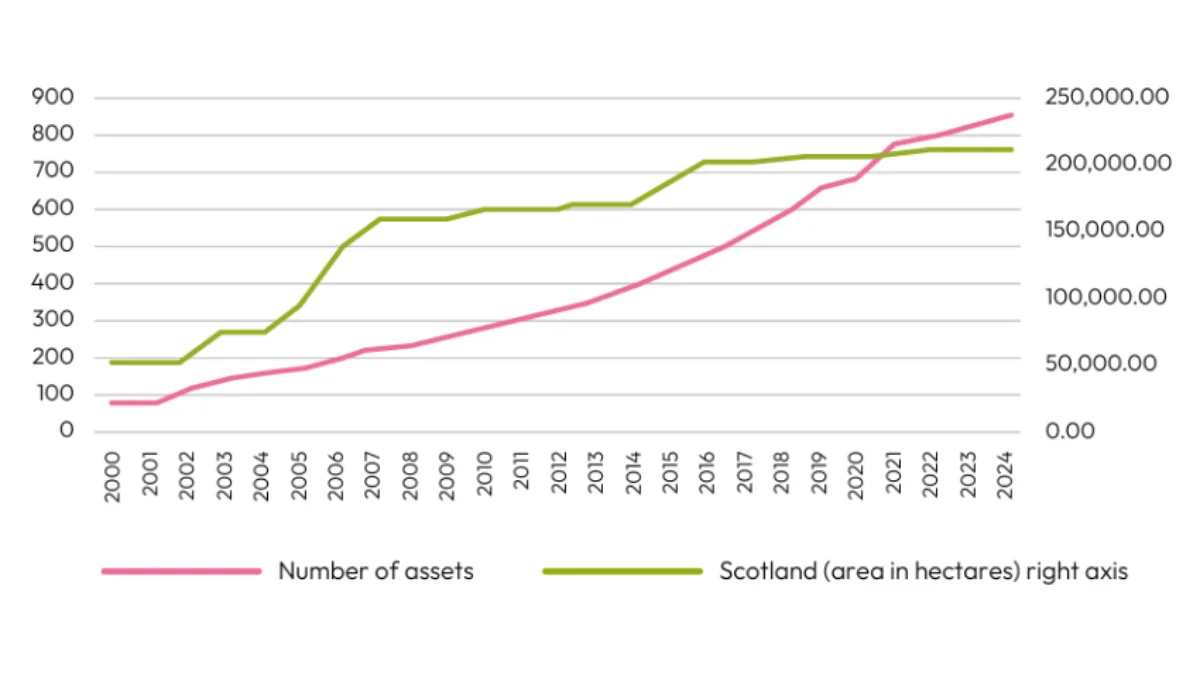
The latest Scottish Government assessment published in 2025 shows that community ownership in Scotland has seen steady growth as shown in figure 1.14 A total 853 assets managed by 503 distinct community groups in 2024. Most holdings consist of land and buildings covering 213,803 hectares (2.7% of Scotland’s total land area). The portfolio also includes 21 unique non-property assets such as ferries, boats, a car transporter, and salmon fishing rights.

Community ownership is heavily concentrated in rural regions, which account for 80% of all assets and more than 99% of the total community owned land area. Na h-Eileanan Siar remains a central hub, containing 153,678 hectares (72% of the national total). Collectively, the Highlands and Argyll and Bute local authorities house 326 assets, making up 38% of all community-owned holdings. There are 104 urban assets compared to 686 rural assets.

Figure 1: Number of assets and area of assets in community ownership for in Scotland, 2000 to 2024 - data from Scottish Government Community Ownership in Scotland 2024 (15)

Research by Community Enterprise highlighted “cold spots” of community led activity, showing that 80% of cold spots are situated in the Central Belt, while rural areas condense more community ownership activity. Results suggest that increased deprivation is potentially linked to lower community led activity. Warmest spots are concentrated in the Scottish Borders, Shetland, Na h-Eileanan Siar, Stirling, and Orkney, while the coldest spots are in Aberdeen, Lanarkshire, East Dunbartonshire, and Falkirk.16

Furthermore, recent research on large-scale community land ownership (greater than 500 Ha) shows that the majority of large-scale acquisitions are located in the Western Isles and Highland, accounting for over 75% of acquisitions and over 94% of hectarage between them. Crucially, the number of acquisitions has slowed down in the past decade despite a steady demand from communities.17

Community ownership has been embedded and reviewed within the Scottish legal framework for decades through the Transfer of Crofting Estates (Scotland) Act 1997 Land Reform (Scotland) Act 2003, Community Empowerment (Scotland) Act 2015, Land Reform (Scotland) Act 2016. Communities can secure land and assets through several distinct pathways. These include direct negotiation with landowners or exercising statutory Community Rights to Buy, which allow groups to register an interest in land (whether currently on the market or not).

For publicly owned assets, groups may submit a Community Asset Transfer request, while the Ownerless Property Transfer Scheme addresses land that has fallen to the Crown. To fund these acquisitions, communities typically leverage the SLF, supplemented by charitable grants, philanthropy, or commercial lending. In 2025, the Scottish Government has consulted on the Community Right to Buy legislation. The Scottish Land Commission has previously commissioned research relating to community ownership, the mechanisms available, and options for funding (Table 1).

Table 1: Reports commissioned and published by the Scottish Land Commission on mechanisms and financing of community ownership

TitleAuthorsYearScope
Review of the effectiveness of current community ownership mechanisms and of options for supporting the expansion of community ownership in ScotlandRob Mc Morran (Scotland’s Rural College), Anna Lawrence (Random Forest Ltd.), Jayne Glass (Perth College UHI), Jon Hollingdale (Community Woodland Association), Annie McKee (James Hutton Institute), Diane Campbell (Independent Consultant), Malcolm Combe (School of Law, University of Aberdeen)2018Community ownership mechanisms
Community Ownership and Community Right to Buy Recommendations to Scottish MinistersScottish Land Commission2018Community ownership mechanisms
Review of International Experience of Community, Communal and Municipal Ownership of LandRob Mc Morran, Jayne Glass, Jane Atterton, Sarah Jones, Eugenio Perez Certucha (Rural Policy Centre, Scotland’s Rural College); Annie McKee (James Hutton Institute); Malcolm Combe (University of Aberdeen); Ting Xu (University of Sheffield)2019Community ownership mechanisms
Range, Nature and Applicability of Funding Models to Support Community Land OwnershipDuncan MacPherson, Faye MacLeod (Campbell Stewart MacLennan & Co), Josiah Lockhart (Firstport)2019Community ownership funding models
Community Funding – Model TableScottish Land Commission2019Community ownership funding models
Community ownership financing: options to complement the SLFDuncan MacPherson, Faye Macleod (Campbell Stewart MacLennan & Co), Willie McGhee, Douglas Westwater (Community Enterprise), Pamela Redpath (Community Enterprise), Joel Paterson (Bowlts Chartered Surveyors)2021Community ownership funding models

5.2 Challenges and opportunities raised in previous work


While community ownership in Scotland continues to experience steady growth, local groups face interconnected legislative, geographic, administrative, and financial hurdles.

The statutory routes designed to empower communities including the various iterations of Community Right to Buy and Community Asset Transfer are perceived as highly bureaucratic and complex. Instead of utilising proactive planning, communities are frequently funnelled into reactive legal processes that can take years to resolve. Groups face extensive delays, mapping burdens, and difficulties simply identifying actual landowners due to offshore trusts and obscure corporate structures with up to 30% of urban projects stalling due to fragmented, complex ownership pattern.18

There is a significant geographic imbalance in asset distribution. Over 99% of community-owned land area is concentrated in rural regions, leaving the central belt and urban settings highly underrepresented.19 There is latent demand in cities, yet urban groups located in highly resource-deprived areas show slower progress unlike rural communities that benefit from decades of foundational capacity-building, urban groups often lack a long term support network, making their organisational journeys longer and more fragile.20

Some community groups have reported the heavy operational toll of navigating these processes relying on small groups of local volunteers. This friction is exacerbated by local authorities and Arm’s Length External Organisations (ALEOs) who sometimes view community groups as commercial competitors and block Community Asset Transfers to retain future revenue streams. 21, 22, 23

Financing remains a critical bottleneck. The sector suffers from a “hierarchy of descent” where groups rely almost exclusively on the SLF because they lack the specialised skills or structural capacity to manage complex debt-based models, social investments, or green capital.24

Although speculation around natural capital may have eased in recent years, land prices make land acquisition unaffordable for many communities.25 Finally, there is a severe shortage of post-acquisition and development funding; without long-term revenue support to manage assets after the initial purchase, smaller or disadvantaged community groups struggle to remain financially sustainable.26, 27, 28

International evidence shows that community empowerment can be achieved through disaggregated rights, where groups manage specific resources (like timber or water) without the prohibitive cost of full title transfers. In countries like Germany, communal management is a proactive, culturally embedded component of statutory planning. Evolving past a reactive “buy-out” culture represents a major opportunity for Scotland.29

In 2018, the Scottish Land Commission made recommendations to enable communities to be more strategic rather than reactive, simplifying the legal and administrative mechanisms and considered the role of funding and finance alongside other approaches to building capacity.30 Most recommendations, in particular those regarding funding and finance, remain relevant today.

5.3 Interview findings


This section highlights key points raised by participants during the interviews.

Process and mechanisms for community acquisition

Participants state that volunteer-led community groups face an unlevel playing field, going up against the sophisticated, well-funded legal teams of public bodies or fast-moving private buyers without equivalent legal support. Highly technical guidance and processes, rigid administrative conditions and uncooperative landowners can cause projects to stall or fail.

Various community ownership routes including Community Asset Transfer were discussed. Although the Community Asset Transfer process is generally highly regarded and considered as functional there are mixed experiences. These seem to be impacted by the skill and knowledge of officers, capacity of relevant authority staff to understand and engage in the process, and suitable governance processes in the relevant authority. In practice, public bodies lack a standardised approach to defining “best value,” with some prioritising long-term social investments and others focusing strictly on extracting the maximum market price.

The Community Right to Buy is sometimes seen as overcomplicating an acquisition that could otherwise be resolved via a direct, negotiated sale. Stakeholders emphasised that early, collaborative communication with landowners is preferable. Some landowners can react defensively to registration of interest and the Community Right to Buy process, which suggests a need for better awareness of the process and its intentions. At the same time, communities should be encouraged to register interest in assets that could meet community needs before they hit the market.

Some stakeholders argue that long-term or concessionary leases should be embraced more widely as a lower-risk “try out” phase, with suggestions that they preserve community capital for project development rather than upfront purchase. However, it is acknowledged that it can be more difficult for communities to secure funding to invest in assets that they do not own.

Some participants suggest that there needs to be greater clarity and proactive communication around disposals and opportunities for delivering community aspirations. The means to achieving this need to be implemented across all sectors and coordinated across policy areas.

Funding

It was clear from our interviews that the SLF provides an invaluable source of funding and support across Scotland and that the community land sector would not be as successful as it is today without it. It is vital to retain the fund on an ongoing basis to ensure the continued empowerment of communities and delivery of benefits that meet local needs.

There was acknowledgement from participants that public money is tightening and that it is important to make sure that the SLF continues to be well-managed with clear criteria for success. There were also some discussions about the merits of moving the SLF from a purely “demand led” model to a “policy-led” model. However, it is clear that any change in criteria would need to be well thought out to ensure that communities across Scotland can still benefit from access to the fund.

While the SLF is highly effective for asset acquisition, participants mentioned there is a critical funding gap for post-acquisition development and capital works, especially with rising construction costs in rural areas. Funding to hire dedicated project officers on an ongoing basis was also raised as essential as relying solely on overstretched volunteers creates major fragility for project viability.

The growing demand and appetite for community-owned assets of all types is outstripping available funding of the SLF. There has been an increase in applications for buildings in recent years driven in part by response to significant asset disposals by public bodies.

Timescales were frequently mentioned by respondents as challenging. Single-year funding cycles are perceived to put immense pressure on communities, who risk losing grants if a sale isn’t completed by the end of the financial year; participants mentioned the need for more budget flexibility. There is often a misalignment between funding timescales and acquisition processes.

Support and enablers

Although conversations around “community capacity” are prevalent in the community land space, some participants emphasise that communities don’t lack capability or skills; they lack time, as members have responsibilities with families and day jobs while navigating overwhelming bureaucracy in their evenings. Current mechanisms are failing to reach disadvantaged areas, with data showing a distinct lack of Community Asset Transfer activity within lower Scottish Index of Multiple Deprivation (SIMD) percentiles.

Most participants believe that third sector support organisations and access to specialist skills such as consultants or legal and architectural expertise, are essential for successful community ownership projects. It is important for communities to understand ownership and development options early on. Organisations like Community Land Scotland, the Development Trust Association Scotland, Community Woodland Association, and regional enterprise teams such as Highlands and Islands Enterprise and South of Scotland Enterprise are viewed as indispensable, trusted support that need expanded, long-term funding. Stage 1 funding through SLF successfully helps groups hire consultants to de-risk projects, but there are growing complaints about shortage of consultants and a rise in expensive, “cut-and paste” business plan templates.

Community ownership studies and policies skew heavily towards rural areas, leaving urban groups to navigate distinct challenges where a large portion of buildings require expensive refurbishment just to keep the doors open. There are gaps in this area and delays can mean that the condition of buildings deteriorates leading to increased costs.

Some participants note that success should not just be measured by the number of acres or assets in community hands, but by the long-term financial viability of the projects and how supported the community felt throughout the process.


12 Scottish Government (2017) Scottish Land Rights and Responsibilities Statement. 

13 Scottish Government (2024) Community Ownership User Guide. 

14 Scottish Government (2025) Community Ownership in Scotland 2024.

15 Scottish Government (2025) Community Ownership in Scotland 2024. 

16 Community Enterprise (2024) Cold Spots of Community-led Activity. 

17 Macaulay, B. et al. (2026) SEFARI Fellowship to understand changes in demand for largescale community land acquisitions and identify barriers and solutions to new acquisitions.

18 McMorran, R. et al. (2018) Review of the effectiveness of current community ownership mechanisms and of options for supporting the expansion of community ownership in Scotland.

19 Scottish Government (2025) Community Ownership in Scotland 2024. 

20 Community Land Scotland (2024) Community Ownership Hub: Final Report Summary.

21 Doyle, C. (2023) “Rethinking Communities, Land and Governance: Land Reform in Scotland and the Community Ownership Model,” Planning Theory and Practice. 

22 McMorran, R. et al. (2018) Review of the effectiveness of current community ownership mechanisms and of options for supporting the expansion of community ownership in Scotland.

23 Community Land Scotland (2024) Community Ownership Hub: Final Report Summary. 

24 MacPherson, D., et al. (2019) The Range, Nature and Applicability of Funding Models to Support Community Land Ownership.

25 Macaulay, B. et al (2026) SEFARI Fellowship to understand changes in demand for largescale community land acquisitions and identify barriers and solutions to new acquisitions. 

26 Macaulay, B. et al (2026) SEFARI Fellowship to understand changes in demand for largescale community land acquisitions and identify barriers and solutions to new acquisitions. 

27 Morran R. et al. (2018) Review of the effectiveness of current community ownership mechanisms and of options for supporting the expansion of community ownership in Scotland. 

28 MacPherson, D. et al (2021) Community Ownership Financing: Options to Complement the Scottish Land Fund. 

29 McMorran, R. et al. (2019) Review of International Experience of Community, Communal and Municipal Ownership of Land A report to the Scottish Land Commission. 

30 Scottish Land Commission (2018) Community Ownership and Community Right to Buy Recommendations to Scottish Ministers.
Cta img

STAY CONNECTED

Get the latest news, research and events from the Scottish Land Commission direct to your inbox