3.3 Desired changes and anticipated impacts: Dominant themes
3.3.1 Ownership patterns and distribution
A primary concern identified by participants is the high concentration of land ownership in Scotland. Respondents frequently argued that the concentration of land in the hands of a small group is inherently linked to a disproportionate accumulation of power, resulting in a perceived lack of agency and influence for local residents, communities and business.
“I would like to see communities empowered to own their own land, the break-up of large estates and the power imbalance that causes. I am concerned that land is owned by people distant from the day to day lives of those who live and work on the land.” 174
“Break up large land ownership. Limit the amount of land any individual, company or trust can own. This would allow more people to own land, more taxes would be paid, communities could have more say, more local trades would be used, communities would prosper, etc, etc.” 105
“Land is power and those owning great swathes of it can exert economic/political/social/ environmental influences which may not be to the advantage of local communities and thus the country as a whole.” 760
The issues associated with concentrated ownership are exacerbated by the absenteeism of some landowners. Participants noted that large-scale landowners, whether private individuals or corporate bodies, are often physically and culturally detached from the land. This often leads to a lack of engagement with local stakeholders and a disconnect between the decision-makers and the communities affected by those decisions.
There is a strong perception that current ownership models prioritise private financial interests over local socio-economic development. Participants expressed concern regarding capital extraction, where the financial yields from Scottish resources benefit foreign investors rather than being reinvested into local infrastructure or wealth building.
“The owners of land should live and work there. Absenteeism drives detachment from the real challenges and opportunities facing our communities.” 8
“I should like to see a reduction in the power held by large corporations inflicting large development projects such as 'wrong tree in the wrong place' commercial forestry, inappropriate windfarms and other devastating changes, with an often very negative impact on communities, land-use and the environment. These entities are becoming famous for holding 'tick-box' so called 'consultations' with locals without any intention of modifying plans, which are more around corporate greed and enriching shareholders than benefitting communities and the environment.” 55
A linked recurring theme was the opacity of land ownership information. Participants emphasised an urgent need for greater transparency regarding ownership and management, suggesting that the lack of information fosters mistrust within the land system and hinders local engagement.
“Transparency of land ownership should be free and much easier to access. Including landowner plans for the future that are consulted on with local communities.” 8
“Make clear who or what organisation owns every square inch of Scotland, and make the information easily accessible by the public. Include what the responsibilities are which landowners have to comply.” 1154
“Full transparency on the ownership of estates over 1,000 acres. All estate sales to be open with a potential purchaser subject to a public interest test on their environmental policies, involvement of the local community etc. Estates to regularly submit to a public interest test so that the local community can hear about and affect policies/developments.” 172
Respondents called for a fairer and more equitable pattern of land ownership often arguing for the expansion of community ownership as a primary solution. Public ownership was also raised as a potential solution by respondents. These were framed as mechanisms to democratise diverse land uses and ensure that management aligns with local people’s needs.
“More land being owned by more people, not just most land being owned by a few. Much more land in community ownership, so that communities can have more control and benefit more from the way that land is used (e.g. windfarms). Much more land being used in ways that benefit nature and the environment as well as people.” 241
“A more diverse pattern of ownership, more land owned by local communities.” 875
“More public/communal ownership of land. Redistribution of land ownership. Diversification of land uses guided by societal wellbeing goals. Restriction of the domination of corporate powers defining land use agenda (e.g. expansion of carbon credit schemes, as well as data centres).” 689
However, a small number of respondents expressed scepticism regarding the efficacy of community and public ownership, citing potential issues with management capacity and long-term financial sustainability. Some respondents highlighted the vital role of private ownership in the rural economy. These participants argued that private estates provide essential investment and management expertise that public or community bodies may lack.
“Estates and Farmers to continue to be supported to grow our food to keep the country fed. That is good for all of us. Community land isn’t important, it will only work as long as it’s funded heavily and has the right people running it, risky I would say.” 428
“Push to community ownership is misguided. More attention needed seeing how existing community owned land performs over decades.” 65
“I'm in favour of predominantly private ownership. This avoids a burden on the public purse when there is insufficient public monies available for core public services. Private owners are on the whole excellent land managers and caring employers and community servants.” 455
On many occasions participants identified specific policy levers for change, such as the introduction of stricter residency requirements for landowners to ensure local benefits are preserved. The potential for residency requirements was raised by a large number of respondents, ranging from more significant to more nuanced measures. Taxation and fiscal interventions were also considered as necessary policy levers and were regularly associated with the theme of residency.
“To be owned by Scottish people” 521
“A degree of residency should be mandatory if buying large swathes. Why couldn’t there be a fixed term non freehold obligation with sale of large areas of land to non residents, perhaps including the option to remove ownership should an agreed level of residency not be attained?” 760
“The owner should reside more than 6 months a year in Scotland and pay taxes in Scotland including income and investment taxes in Scotland.” 532
“Introduce Land Value Taxation (LVT), initially as a replacement for Council Tax. Then systematically increase reliance on LVT while reducing distortive taxes on employment and enterprise, such as income tax, to make use of Scotland's devolved tax powers.” 12
“We need much higher tax on unearned wealth and land hoarding, especially for land used for environmentally damaging activities (i.e. grouse shooting estates) and to close the legal loopholes which mean that these estates can avoid the taxes that poorer people are subject to, and remove any form of state support and subsidy.” 919
A number of respondents were in favour of less change or to maintain the status-quo on large-scale ownership which they consider the most viable path forward. They contend that the large-scale management opportunity provided by large scale landownership is necessary for environmental benefits and local employment, and that government intervention should be minimised to maintain market confidence and encourage long-term capital investment. Some contributors warned against the sentiment of "vilification" towards private landowners, suggesting that land reform ambitions are often driven by particular beliefs or prejudicial stereotypes rather than based on sufficiently compelling evidence.
“None. As a believer in the free market, I consider that the State should not interfere. The evidence for Scots having suffered some disadvantage from the current free market in land and its use, is not compelling.” 160
“It would be great to see a reduction in legislation & red tape that cripples the rural economy. Land Reform has effectively only brought more regulation and less ability to effectively develop businesses in the rural countryside. Who owns the land isn't the issue that stops economic development, it is the overregulation & socialist mentality of the governing bodies that is the issue.” 896
“Land use in Scotland is very complex! However there is an increasing feeling amongst many land managers/owners that they are under attack simply for being involved with land that is privately owned and are therefore somehow 'evil', colonial etc; this is increasingly how I feel the debate is being framed […]. It is the 'shouty'- do as I say not what you think' gang that have a hold on the political, social and climate change bandwagon that is skewing fair debate. I am not against community buyouts or any of it I just want landowners and managers to be recognised for their fairness and best efforts at reforming and adapting to the 21c.” 365
“There should be no prejudice against large private landholdings. They are the most likely to bring outside wealth into the countryside and are the most likely to generate wealth, give people employment and support local communities.” 838
While many respondents believe that changing the who (ownership) is a prerequisite for better management as well as community benefit, others argue that the how (stewardship) is the more critical factor, regardless of ownership. This focus on land management and accountability is explored further in the following section.
3.3.2 Land management and responsibilities
A portion of the participants suggest that the discourse surrounding land reform often misplaces its emphasis on ownership. Their perspective is that the systemic issues identified such as environmental degradation or lack of community access, are primarily functions of management rather than ownership, placing responsibility on the practices of landowners/managers rather than the fact of their ownership.
Although a small number of respondents considered that practices of large landowners are currently satisfactory, some recognised a need for land management obligations and enforcement of environmental standards. They posited that if management duties are carried out responsibly, the amount of land owned becomes a secondary concern, adding that regulation of landownership may have a negative impact on existing good practices.
“I believe in the right of a private individual to own land and that that individual is best placed to take responsibility for its stewardship. I believe that society should impose standards in relation to the environment but there is, currently, far too much interference with contractual arrangements over farms and houses which make normal business interaction challenging.” 385
“Fundamental change such as is proposed by restricting the size of landholdings will be very damaging to the ongoing excellent nature restoration work (supported and encouraged by successive Scottish governments) that is being done in so many parts of Scotland.” 370
Participants argued that their experience and knowledge is essential for the effective management of Scotland's rural assets and should be central to any policy-making process. Respondents frequently highlighted the importance of recognising expertise and hearing the voices of those with direct, practical experience in the field, such as farmers and land managers. There was a notable sentiment that these individuals are often unfairly criticised in public discourse, and by people they considered to have insufficient knowledge. Some respondents go as far as valuing solely the expertise within their immediate sector. Linked to the themes of expertise and knowledge, there was a notable reluctance to follow directives from government bodies or external "experts" presumed to lack on-the-ground experience. This suggests there can be significant tension between practitioners and public policy.
“Land must be owned by those with the skills and understanding to maintain it and those who have a personal attachment to the property beyond simply looking for an ROI. Without personal investment in the property, the long-term outlook cannot be sustained. We must also move away from an obsession with ownership and focus on the management. Communities do not need to own an asset to enjoy the use of it and without large scale ownership, employment in rural areas will drop further. With this will be the loss of key skills learnt over generations of wildlife and landscape management. The recent wildfires in the Moray and Highland region highlight the vital role that estate staff fulfil in protecting the landscape for their invaluable contribution to local communities This cannot be undervalued.” 371
“Let policy be led by those who know the land, not academics and environmental protestors in cities. incentivise private property owners and landowners to seek tenants - to create affordable housing, and to have security within their asset properly regulate the ridiculous "carbon credit" industry - and stop the greenwashing.” 65
“Try to look beyond the "nasty private landowners" and take advice from those that know, not those, as is current, who think they do.” 1021
“Allow farmers to make decisions as they understand nature better than all these suits in ivory towers. What a mess these suits are making of policy.” 1151
A recurring theme was the idea that land ownership comes with socio-economic and environmental responsibilities. This idea is linked to the notion that land should be managed in a way that serves the wider and long-term public interest. However, different perspectives on what public interest entails emerged from the responses, with some focusing on local interest while others focussed more implicitly on wider public interest.
“Scotland has made progress on land reform, but more is needed to make ownership truly transparent, accountable, and in the public interest. Too much land is still held by a small number of private interests, often shaped more by inheritance and investment than local needs. This can limit access to land for housing, food growing, small businesses, and environmental restoration. I would like to see tighter limits on concentrated ownership, a more proactive approach to community buyouts, and stronger planning and tax policy to support productive, sustainable, and locally led land use. Ownership information should not just be public but easily usable by communities and policymakers. These changes would help ensure land supports the people who live and work on it — not just as an asset, but as a shared foundation for community resilience and regeneration.” 214
“We want land to be used in ways that reflect community priorities: sustainable jobs, biodiversity, and real contributions to net zero—not just energy exports. Reforms must ensure communities have meaningful control over what’s built on their doorstep, with public interest, not corporate gain, at the heart.” 576
“We are in a biodiversity and climate crises, yet conversations around land reform rarely focus on this. Land reform should be about much more than diversification of ownership - it should also be about compelling those who DO own large amounts of land to use it in the public interest to a much higher degree than is currently happening.” 16
Some participants advocated for a public interest test on current landholdings and large-scale land transfers to help ensure that the public interest is safeguarded. Others advocated for more stringent fiscal penalties for poor management practices, focusing on a more punitive approach where land is neglected or against practices that prioritise short-term gain over long-term sustainability.
In contrast, other respondents adopted a more utilitarian, profit-driven vision of land use focusing on economic benefits and productivity as priority. Within this group, there was a perception that business owners, farmers and land managers, should have the greatest control and influence over land decision-making with a focus on profitable use.
“Reform must include real penalties for owners who do not consult on sales or share land management plans - placed on a statutory footing and enforced by a well-staffed commission. It must also include a public interest test and a more restrictive limit on the size of purchases. To my home community of the West Highlands and Islands, it would mean having more say over our land, and it would help repeople an area that is in crisis and desperately needs housing and an economy that goes beyond seasonal tourism.” 127
“Public interest test being applied to sales and use of significant landholdings – too much marginal/wild land in very poor ecological condition due to mismanagement, ‘traditional’ sporting regimes, or neglect.” 1171
“Farmers should run the land, either as tenants or owners. Owners should own the land and develop the land for its best and most profitable use based on its intrinsic nature. The public should be able to enjoy the land via hiking and visiting and camping etc but without disruption to the communities where the land is based. The government should enable these principles to be adopted and maintained.” 833
Ambitions for improved management are frequently framed through a dual commitment to community benefit and large-scale environmental health. Those respondents often suggest that responsible stewardship is seen as a vehicle for balancing economic productivity with nature restoration.
The responses demonstrate a wide range of positions on what constitutes appropriate land use or “sustainable land use”, reinforcing that good management is a place-specific, multifaceted and subjective concept. Participants held divergent, and often negative, opinions on specific practices such as commercial forestry, farming practices, rewilding, or grouse shooting.
A number of respondents favour only certain types of land use while other are in favour of a more integrated land use approach. The delicate and conflicting nature of those interactions among land uses was underlined by respondents calling for more integration and collaboration.
“Would like farmland and hillsides to continue being used for farming/game rearing purposes only.” 1168
“Scotland's land-use practitioners - farmers, gamekeepers, estate owners, foresters etc, generally interact with other land users in a fractious manner with often poor consideration/ integration of competing or even complementary land uses. For example, a common mindset often expressed to us is that farmers 'hate' trees. Gamekeepers 'hate' trees. Foresters 'hate' sheep and on it goes. It is rare to find land users in Scotland that have a truly balanced view on a variety of uses that can co-exist. This widespread mentality is detrimental to wider land-use discussion between user groups and to the progression of a fully diversified rural landscape.” 197
This lack of consensus is most visible in the differing definitions of sustainability. For some, sustainable land use is synonymous with productive farming and "tidy" landscapes; for others, it implies a transition towards management primarily for nature recovery. This tension regarding the ultimate purpose of the land will be discussed in the following sections on nature and biodiversity, energy production and development of the landscape and agriculture.
3.3.3 Nature and biodiversity
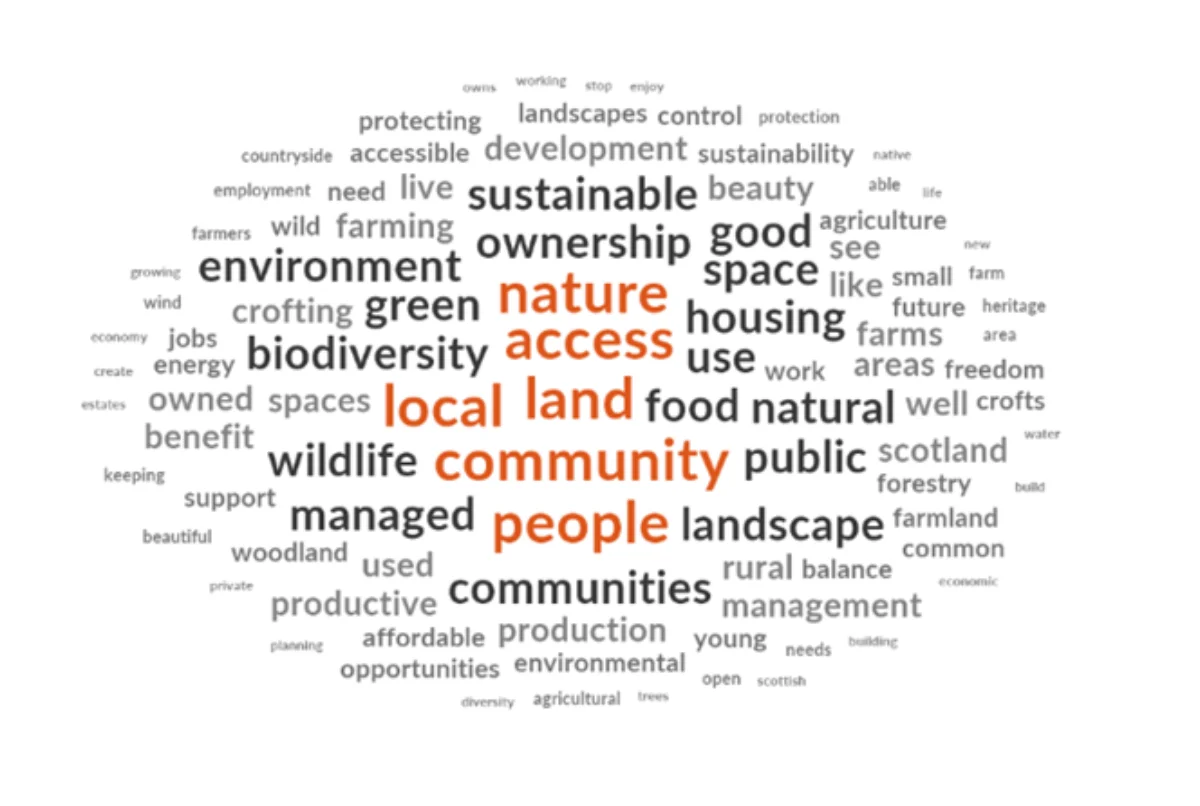
Biodiversity and nature emerged as the most dominant theme within the dataset, appearing more frequently than any other topic across the responses. Respondents overwhelmingly identified biodiversity and environmental health as key priority factor for successful land use. However, while the importance of biodiversity was acknowledged by a wide number of people, the proposed approaches for achieving it varied: from a vision where biodiversity conservation coexists with traditional land uses to a strict preference for the restoration of “wilderness”.
“I'd like wild land to be protected to the highest degree. We are so fortunate to have the land that we have, that people travel hundreds and thousands of miles to come see. It must be protected.” 615
“I would like to see support for people to build an ecologically (and economically) sustainable life and livelihood on the land. I would like to see more communities benefit from the opportunity presented by the land surrounding them. I would like to see all layers of governance supporting sustainable communities in all parts of Scotland.” 32
The responses indicate a strong link between environmental preferences and the cultural heritage of the landscape. For many, the visual appearance of the Scottish landscape is inextricably tied to their sense of local and even national identity. This results in sharply differing visions: some participants view existing landscapes as a cultural asset to be preserved, while others see a need for nature restoration. This also links to the divide in how respondents perceive appropriate management of land and nature in Scotland. Some view the landscape as something to be preserved "as is", fearing that radical changes will destroy established ecosystems and traditional scenery, others consider that change is needed to restore lost environments.
“I would like to see land use stay exactly the same as it is currently. I love the amazing unspoiled landscapes and currently landowners are doing a great job in protecting Scotland's natural heritage.”650
“Locally led restoration and regeneration of the landscape alongside community-owned and managed renewable infrastructure. No more large-scale industrialisation of the landscape with private-funded developments. Reforesting with native mixed species and deer management. Community involvement in natural landscape regeneration with community initiatives for sharing in the benefits of that renewal.” 688
Rewilding occupies a controversial space within the narrative. To a portion of respondents, rewilding represents a positive, necessary return to a natural state, offering benefits for reforestation, species reintroduction, and climate resilience. Conversely, a substantial number of participants expressed deep scepticism, framing rewilding as it is currently practiced as a form of "greenwashing". The emergence of corporate entities or wealthy individuals purchasing land for carbon credit schemes – often termed "Green Lairds" – was a recurring concern. These respondents argued that such models are often driven by financial gain or tax avoidance rather than genuine ecological concern, potentially impairing local community sustainability in the process. While large-scale rewilding is often the focus of national debate, the responses revealed a significant willingness among individuals and communities to take charge of projects at a local level. This bottom-up approach to nature restoration is seen as a path to democratise and increase local stewardship for environmental action.
“I would like to see more land used for rewilding programmes and biodiversity projects. In my opinion, land being used in such a way will bring about a more positive community environment as people will have natural habitats that they can explore and spend their time in. It would also make a big difference to me as I want to go into habitat restoration and such projects would provide me with more work.” 739
“I want to see an end to absentee landlordism, land hoarding, greenwashing, plantation woodlands, sports hunting. I want to see more community ownership, more crofts, more homes for young families in the Highlands. Repeopling and ecosystem regeneration doesn’t need to be at odds. Green lairds who do not care about the history of the land they have taken and see it only as a wild canvas to play with do great harm to the movement. Gaelic crofting communities safeguard much of the ecological diversity in Scotland. And it is hunting estates like the one near my home that reduce it, by persecuting endangered wildlife. So why are entrusting rich landowners, who are often antagonistic to crofters, being trusted with the important task of ecosystem regeneration?” 945
“Strengthening wildlife protection is essential for managing land sustainably, guided by the International Consensus Principles of Ethical Wildlife Control, which ensure interventions are responsible and ethical towards animals and ecosystems. These changes would empower rural communities, restore our environment, and provide better protections for Scotland’s wildlife.” 213
In contrast to the idea of community driven small-scale restoration, a number of respondents argued that restoration at scale is essential to meet current environmental targets at speed. There is a strong belief among these respondents that large-scale ownership is required to ensure the achievement of national environmental goals, as such landowners can implement landscape-scale interventions that smaller holdings might struggle to achieve.
“Exponents of fragmented land ownership can fail to appreciate the ability of scale landowners to respond to challenges at speed while deploying required resources. In terms of environmental targets however, a ‘mosaic response’ of smaller landowners to delivering solutions or dealing with sudden challenges can significantly delay implementing change.” 411
Environmental and biodiversity concerns extended into urban contexts, where respondents highlighted issues of littering and pollution. There was a strong call for the revitalisation of urban green spaces to improve biodiversity alongside community well-being. Respondents expressed frustration with littering in rural areas as well, impacting nature and enjoyment of natural spaces.
“I live in Glasgow city, I see every green space being bought and redeveloped into student accommodation, I am older I wish they would leave some space for us to breathe, without having to walk so far.” 696
“My suggestion is quite parochial, nevertheless…I have been a registered neighbourhood improvement volunteer in Glasgow for many years during which time I have seen litter and fly tipping reach outrageous proportions. […] Glasgow, is groaning under the weight of litter and fly tipping and free access to the ROS in order to determine ownership is essential or…as is the case at the moment…absolutely nothing is being done and ‘nothing’ is not an exaggeration.” 1098
A number of participants staunchly defended the preservation of the right of access as a fundamental Scottish cultural principle and a precious way to preserve access to nature. However, the findings suggest different perspectives regarding the enforcement of "responsible access" to avoid negative impacts on the environment and agricultural activity. A small number of respondents called for limitations or reconsideration of the rights of access due to disturbances to rural activities and irresponsible behaviour.
“As a former hillwalker/climber, I have witnessed foreign owners of estates trying to block access, despite there being a legal right of access. This has to end. There needs to be better use of huge estates for the people of Scotland and not just foreign or rich fishermen or shooters.” 1176
“I would like to see the RIGHT TO RESPONSIBLE ACCESS brought under more scrutiny as the amount of people that think they can just go where they want with dogs and without, leave litter and cause risk of wildfire by having open fires on land that is supposed to be rewilded. There is less risk of wildfires on properly managed land , farms and estates. Encouraging more people into the countryside does not work for nature as people destroy biodiversity, trampling over nests and upsetting young animals that are very reliant on their mothers. We have a path that runs through our property and we get endless problems with gates being left open and animals getting mixed up which affects their health. Damage to fences and litter. The list goes on. The government owns a significant amount of Scotland so should be Encouraging these areas to be visited more.” 528
“I would like to see the public kept to core paths and banned from all farmland. There should be huge fines from dropping litter anywhere.” 727
Climate change was frequently mentioned as part of these environmental concerns, though notably less dominant than nature and biodiversity-related responses. When raised, climate-related issues were often mentioned in broad terms or as part of a wider holistic vision of sustainability, rather than in detail. Only a small number expressed deep concerns over the climate crisis. Furthermore, renewable energy developments were often viewed through an extremely critical lens.
Participants frequently criticised other large-scale commercial practices, including farming, the burning of grouse moors or commercial forestry, as being detrimental to biodiversity. These practices were framed as being at odds with the ecological potential of the land, a tension that is explored further in the following section.
3.3.4 Land use change and net-zero
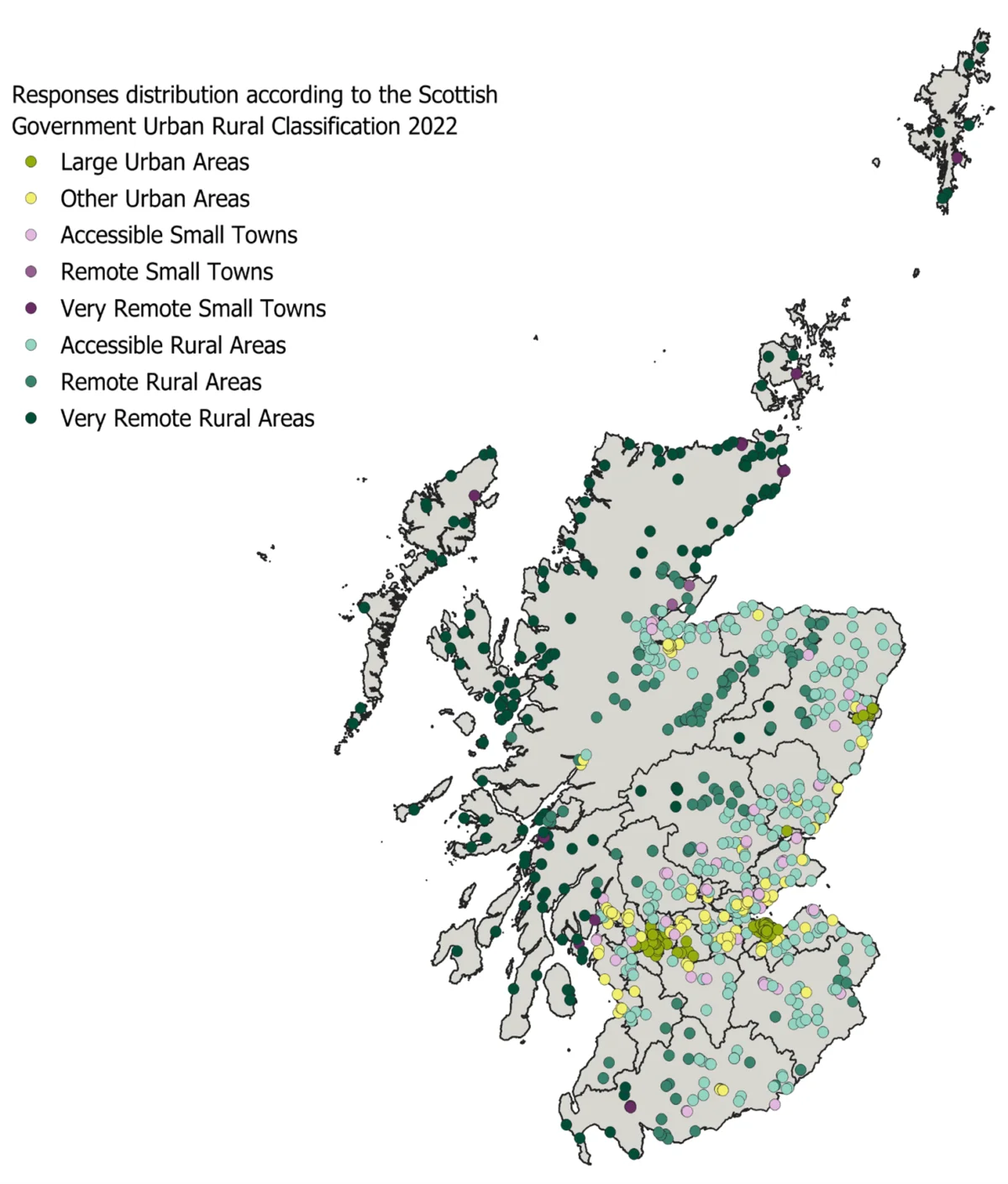
A strong theme across the responses was the negative perception of renewable energy development and related infrastructure. Wind farms, pylons, and solar developments were often described as industrial intrusions that scar rural landscapes, with “industrialisation” frequently used in a pejorative sense. This concern was closely tied to wider issues about corporate ownership and biodiversity loss, as many participants argued that the footprint and construction of these projects cause lasting damage to ecosystems and local environments. Notably, these views were expressed by both urban and rural respondents.
“Stop the industrialisation of the Highlands. Scotland already produces more electricity than it requires. Energy which is transmitted across hundreds of miles is not green.” 147
“Stop the sprawling energy catchers. Stop the wind turbines, stop the solar panels, stop the shipping container batteries. Stop the expansion of roads into nature. Stop the additional and unnecessary overhead powerlines, stop the additional and unnecessary substations.” 284
The opposition to large-scale renewable energy projects extends beyond aesthetic concerns. Respondents expressed deep anxieties regarding the cumulative ecological, visual, and livelihood impacts of such developments. There is a pervasive sense among participants that the rapid and cumulative developments in rural spaces contributes to a loss of "wildness" and are perceived as threat to local livelihoods, causing significant concerns among respondents. Negative perceptions of these activities were also linked to their competition with existing land uses, in particular agriculture. It is worth noting here that consent was not received to quote some of the most detailed and emotive responses.
“No sales for solar “farms” until the impact is assessed with other applications for same. E.g. Several applications currently in for rural Perthshire at the same time, within a few miles of each other. These according to the Planning dept at P & K are all assessed separately. The culminating impact of these applications are never considered, unbelievable!” 321
“No more poor use of agricultural land for solar. We need food security. Allow the farmers and landowners more autonomy in how their land is worked. They know how to do it. Stop governments from interfering! And stop planting trees on good farmland as well as “rewilding” it’s a disgrace!” 320
The critique of development and large-scale corporate practices was not limited to energy infrastructure. Similar negative perceptions were directed at other commercial-scale practices, most notably commercial forestry. Participants frequently criticised commercial forestry plantations as another form of industrial encroachment that offers little in terms of biodiversity. Similar opinions were also expressed with regards to carbon capture and rewilding activities. This can be linked to the broader concept of “green capitalism”, where rewilding and carbon offsetting are seen as new frontiers for corporate exploitation rather than genuine conservation and calling for more balanced uses with integration of community needs (see quote 945 in section 3.3.3 as well).
“More local community ownership & productive use. Now the landscape is dead and unproductive. No young people are entering agriculture. Commercial forestry, rewilding & bogus carbon credits etc dominate. The village is ageing and businesses are closing. Even tourism is declining.” 990
“Land use for maximum financial gain out of carbon credits has pushed up prices and has created some harmful habitat changes. I think planning consent should be required for rewilding, as its impact on neighbours is very significant. I do not think land should be used for releasing extinct or non-native species without thorough consultation and consideration of local farming businesses.” 177
Linked to these negative perceptions, the net zero agenda itself faced criticism and scepticism, often being linked with a form of forced “industrialisation” of the natural environment. For many, the transition to green energy was perceived as an intrusive policy framework lacking sufficient consideration of local community needs and participation. A recurring grievance concerned the perceived imbalance between corporate gain and community loss (evoked in section 3.3.1). Respondents noted that while large-scale energy projects and carbon schemes generate significant economic benefits for corporate entities, local communities bear the burden of the direct negative effect of the development. These downsides include the loss of physical access to land, degradation of the visual landscape, potential decreases in property values, and the impact on biodiversity.
“The biggest threat to Scottish land is net zero and the use of freshwater for hydrogen production.” 736
“Changes to how land is owned and used is about protected land from any government land grabs or whims. Protected from those who out of spite want to take land from those who have it at the cost of the taxpayer. I don’t want our hard-earned tax contributions to be used to buy land, that which is held by private individuals or companies. I don’t want land to be used as a weapon to force the dogma of net zero or political belief on to a people and culture that values the freedom to choose their own path.” 199
“Land reform must address the unchecked use of rural land for industrial energy infrastructure like battery storage (BESS) and wind turbines—often imposed without community consent, transparency, or benefit. Large corporate developers exploit fragmented ownership and planning loopholes, installing vast energy projects on land that once supported farming, wildlife, and tourism. Local voices are ignored, and profits leave the area. We want land to be used in ways that reflect community priorities: sustainable jobs, biodiversity, and real contributions to net zero—not just energy exports. Reforms must ensure communities have meaningful control over what’s built on their doorstep, with public interest, not corporate gain, at the heart.” 576
In contrast, a smaller number of participants emphasised the urgent need to scale up renewables to meet climate targets. These respondents associated the success of such large-scale transition with consolidated landownership, arguing that large estates provide the necessary scale and capital to host significant infrastructure projects more efficiently than fragmented holdings.
“More of a focus on what is done rather than who has done it. Current obsession with who own land is holding us back from achieving net zero.” 564
“I do not believe wide-ranging changes to land ownership are necessary or desirable. Large estates and their owners are a force for good, bringing vital investment that underpins rural jobs, housing, and infrastructure. They provide the long-term perspective, scale, and financial resilience needed to deliver projects in forestry, biodiversity, renewable energy, and carbon management—initiatives that require decades of continuity and commitment. While community ownership has its place, there are clear limits to how much land can be effectively managed this way. Community initiatives work best when they complement, rather than replace, professional land management at scale. My concern is that increasing regulatory interference risks discouraging investment and stifling growth, just when Scotland most needs private capital to deliver climate, nature, and rural development goals. Policy should therefore prioritise stability and certainty for landowners, enabling confident investment that secures lasting benefits for people, nature, and local communities.” 832
Some participants noted a preference for smaller, local energy projects or increasing the local share of benefits from commercial activities. This was framed as a way to ensure that the benefits of natural resources are retained locally while minimising the industrial footprint on the broader Scottish environment and communities.
“A stop to any more BIG renewable energy projects. Instead, a deployment of localised, small energy production.” 155
“Community ownership. Sustainable farming. Renewables with community shares and increase in percentage benefits. It would help rural services.” 323
“A share of renewable energy profits should go into a regional fund to help communities.” 1178
3.3.5 Agriculture
Agriculture and food security emerged as one of the most critical topics for participants, consistently raised alongside biodiversity in terms of importance. However, the data reveals a wide range of different visions for the future of the sector. A prominent narrative among respondents is the call to prioritise "productive land" for growing food rather than for non-food production uses.
Mirroring the scepticism towards large-scale energy in the previous section, many participants expressed a preference for small-scale, local farming and crofting models over intensive commercial agriculture. There is significant support for regenerative farming to reconnect people with land practices. This vision is not purely ecological; it is also social, with respondents advocating for more opportunities for a broader demographic to work in agriculture, thereby revitalising rural livelihoods.
“I worry about our food security as more and more productive land is used for this mad dash for green energy in a country that is already self-sufficient when the wind blows.” 648
“Good agricultural land should be treasured and protected from being used industrially as we will need it for food production instead of relying on food from overseas. Enormous tracts of good agricultural land is being planned to be used for producing and transporting energy down to England.” 453
“From a bioregional perspective, land in Scotland should be owned and used in ways that are locally rooted, ecologically informed, and democratically accountable. This means shifting away from absentee or corporate ownership towards community trusts, cooperatives, and shared stewardship. Land use should follow the natural patterns of watersheds, soils, and habitats, with decisions guided by ecological limits rather than short-term profit. In practice, this could mean supporting agroecology and regenerative farming, restoring peatlands and wetlands, and replacing monoculture forestry with diverse, mixed woodlands. It also means recognising land as a common good that provides food, water, climate stability, and belonging. For communities, such a shift would bring greater access to land for housing, food growing, and nature, while strengthening local economies. For work, it would create livelihoods in farming, forestry, and ecological restoration that are sustainable and dignified. Overall, reorienting land ownership and use around bioregions would make Scotland’s landscapes more resilient, just, and life-supporting.” 924
In contrast to the regenerative or small-scale movement, a subset of respondents remains committed to maintaining or enhancing conventional agricultural productivity. This group often resists radical changes to land use, citing the importance of food production to maintain the sector’s economic contribution. In some instances, this manifested as a vision where food production should be maximised as opposed to other land uses.
“Land suitable for food production needs to be used for food production - land less suitable would be where necessary food processing could be done. Farming and livestock rearing skills need to be developed and passed on to younger generations. Local or mobile abattoirs also need space. This may not be popular with 'landowners', but being as close as possible to self-sufficient in high quality food is crucial for the health and welfare of all Scots. No housing development needs to happen on agricultural land. There are brownfield sites, disused industrial estates and office complexes which could be repurposed. Profiteering is all that prevents investment being made in change of use plans rather than despoiling of productive countryside.” 280
“Land must be held in a size that makes farms viable as businesses and that gives food security. This in turn will mean that it will be properly looked after.” 361
The responses highlight substantial challenges regarding the current economic viability of farming. Participants frequently pointed to the high cost of land and the lack of available tenancies as significant barriers for new entrants and younger generations. Without addressing these structural hurdles, respondents warned that the future of the Scottish agriculture sector remains at risk.
A notable portion of the dataset reflected a desire for less intervention underlined in section 3.3.1, with some respondents simply expressing a wish to be "left alone" to manage their land without further bureaucratic oversight. A recurring theme of mistrust appeared in the responses from farmers, who often perceive government interventions and legislation as being against them. There is a strong sense of being unfairly targeted or negatively impacted by top-down policies, leading to a defensive stance towards legislative change and a need for recognition.
“We need to get stability into the legislation surrounding land tenure, land reform and ownership. The situation we have at present is very unsatisfactory with legislation changing regularly and the constant fear that land reform changes will potentially be retrospective. This fear is widespread among landowners of all scales from large (thousands of hectares) estates to small (less than 100 hectares) owner occupiers and results in very few agricultural tenancies being offered. Farming and Crofting is an ageing profession and workforce, there are lots of young capable and keen people wanting to enter the industry but without tenancies they have no realistic prospect of achieving their dream. From a personal basis I am 65, farm about 90ha and would like to let out some of the land on a short to medium duration tenancy for a new entrant to have a go. My professional advisors tell me not to do it due to the legal instability which exists that could have serious impacts on my children should they wish to farm on their own account in the years to come. I am not alone in this predicament. Large estates are similarly cautious. Without new entrants the future for Agriculture is bleak.” 204
“I would like there to be a thriving tenant farming sector where new entrants can get a start in farming and landowners are also not penalised or vilified by policymakers and the general public. I believe it is important that there is a situation where tenants and landowners can have a healthy relationship that benefits both parties and allows rural communities to thrive. I would also like the blanket planting in trees of productive land to stop immediately it is causing depopulation and is also very foolish and shortsighted.” 208
“Less government interference and less negative press than landowners are bad. More respect for ownership / tenancy rights and more respect and appreciation that the land forms part of our business. More support from government and more recognition from government for what we actually do. Active and responsible crofters and farmers play a vital role in delivering high quality food and high welfare standards while providing for and helping sustain biodiversity. As a crofter, and in an active and vibrant Crofting county, we have a beautiful landscape filled with cattle, sheep, silage / crop with a vibrant biodiversity filled with rare species such as curlews, lapwings, oyster catchers, snipe and other waders, endangered species such as Shetland bumble bee, twite and linnet and wildlife and rare flower species to name a few. Recognition is needed to reflect what we are doing (our farming / Crofting practices) (without a government scheme) can work in collaboration with nature. Crofters and farmers are not the bad guys.” 1179
Crofting was identified as an important component of Scotland's cultural and agricultural heritage. Participants called for an urgent intervention to ensure that crofts are actively worked on rather than left unused. Expanding the availability of crofts was framed as a key solution for improving land access for young people. Similarly, the need for more robust support for new entrants, crofters and tenant farmers was a clear priority. Tenants were described as facing unique challenges under current ownership structures, often lacking the security needed to invest in long-term sustainable practices.
“There is so much abuse of the crofting laws with absentee tenants, crofts being left to overgrow and fences falling down because the owners don't live here, have no interest in crofting but want to keep the land as an asset for selling down the line. The village I have moved into has a good community presence regarding crofting and livestock, we do gatherings together, scanning, dipping and generally all work together to benefit each other. This "community" vibe is lost in most other places. At least 3 crofts in the 15 or so in my village are unused, fences rotten and grass overgrown. There are plenty local youngsters who would jump at the chance to work a croft, as buying one is out of reach for so many here. If tenants aren't going to use them they should at least sublet so someone can.” 1020
“More land available to farm especially for young farmers or Crofters, we desperately need a knowledgeable rural workforce.” 1192
“Crofting provides heritable, secure tenancies on modest parcels, typically within township common grazings. This stability—access to land without exposure to speculative pricing—offers a unique advantage in today’s search for rural regeneration. However, if crofting is to serve as a bridge between land access and market engagement, it must be governed closer to the communities it affects.” 176
The discourse also emphasised the intersection of farming and broader community resilience, particularly through participation in food production including in urban spaces. Respondents advocated for increased access to allotments and shared gardens to enable communities to utilise land sustainably for local benefit. The agricultural discussion overlapped significantly with the broader theme of livelihood and local stewardship which will be explored in the last section.
“The enabling of every town/ village to have an allotment or shared community gardens for all ages, categorising land on its worth prevents it being used sustainably by the community.” 645
“More land for allotments and community gardens as well as playgrounds and parks in areas where there are none.” 911
3.3.6 Local stewardship and placemaking
This section examines the themes of community stewardship, the role of heritage and the need to build livelihoods and local resilience. These themes consistently emerged, and often underpinned the responses analysed, in the previous sections. These issues constitute central threads in people’s narratives and shape the reasons behind their positions on land issues. As such, they form the last key elements needed to complete this analysis.
As described in section 3.3.1, many respondents argued that current ownership patterns act as a structural barrier to community empowerment. There is a strong consensus among certain participants that the concentration of landownership results in a participation and community empowerment deficit, where local populations feel excluded from the decision-making processes that shape their direct environments. Many participants identified the planning system as both a site of struggle and an area of untapped potential for engaging communities. Some respondents suggested that sufficient opportunities for influence already exist, but are hampered by a lack of proactive public involvement, while others raise issues of transparency.
“Increase the ability of local people to object to changes of land use and development in order to protect local land and spaces. […] Let local people have a real say in what happens on the land around them to stop people feeling alienated and disenfranchised from their local landscapes.” 313
“As a development Trust for our village, our group finds it a challenge to ascertain out who owns what bits of land. When we do find out who the landowner is, quite often the land is being banked by developers (housing mostly) who are patiently waiting for the right time to begin the journey through the planning system. The planning process begins with conversations between planning officers and developers, without any community representation […]. We would like to see more community land ownership, the resources to assist groups become landowners and the funding to ensure resilience. Having a seat at the table would allow our community to be part of the initial talks and plans for creation and growth, rather than feeling that changes are imposed and that residents are given lip service rather than real consideration.” 220
“Members of a community can choose to contribute ideas to the future of land use by responding to planning applications, community councils, local place plans and community bodies. Many people do not engage with existing routes that can influence land use change and are unaware of the work and costs involved in owning land and the jobs and local spend generated by existing rural land management. I think that attention should first be given to increasing rural and urban understanding of existing ways in which the public can already influence land use.” 614
Many responses highlight the issue of "disconnection" from the land. As raised in section 3.3.2, some participants argued that a perceived lack of knowledge of the environment and rural livelihoods among the public justifies leaving land management to experts and existing owners. Conversely, others encouraged a systemic shift towards re-establishing people’s connection to the land going beyond knowledge towards a reconnection to cultural heritage and identity. This concept of "connection to land" extends to a theme evoked in section 3.3.1, where the perceived detachment of absentee landowners and corporate entities is contrasted with the local “care”, interest and stewardship of resident communities.
“Land in Scotland is a national resource that must be better utilised. I believe the majority of people in Scotland have lost connection to the land and we are seeing population decline in rural areas in favour of the central belt. This needs to be addressed” 1017
“Local communities do not want to become a 'vanished kingdom' by unbearably losing all we know, our vital connectedness with our ancient lands and vital seas. Developers lack connection and therefore have no thought of the protection our environment needs. Communities care and therefore are fighting for our lands and our vital ocean engine.” 169
“I would like to see a greater proportion of Scotland's land in public and community ownership. This is an issue of power, who holds it, who stands to gain economically from the economic potential of land, these are crucial questions. It's also a question of identity - who are we, our land is important to that, our communities too, what do they want to do in their place, they are the ones with a connection to the land, a desire to steward it well, not some offshore trust or hedge fund who sees land purely as an economic asset. We are not separate from the land, we are nature, owning more of it increases the potential for more people to live in a way that is close to the land, understands what the land itself wants to be and express, restores biodiversity and reverses depopulation.” 1100
In this context, for many respondents, it is important that developments (such as renewables or forestry) and land use decisions involve local representation and can deliver on local community and wider public interests. Equally important is the opportunity for the community to benefit more from land use changes, regain a sense of empowerment, and be truly engaged stewards of local decisions.
“Too much power and decision making in a few hands. Differences we can see in communities who have managed to own the land are tremendous - increased population, better services, feeling of empowerment etc.” 608
“I'd like to see land redistribution so that the majority of land in Scotland is owned by communities or councils, not individuals or corporate entities, with democratic governance. I want land to be used for the public good (for wildlife, for reforestation and for producing the food and fibres we need in Scotland in agro-ecological ways). For me and my family that would mean having access to a piece of land to put a small, low-impact home on, to reforest and grow some of our own food, and to live with others in community (co-housing).” 636
The responses indicate an emerging strong desire to build and maintain sustainable livelihoods, which many perceive to be at risk. A critical factor in this discussion is housing affordability, identified as a significant challenge in both rural and urban contexts and mentioned on multiple occasions in previous quotes. Specific concerns were raised about the effects of rural depopulation, with many emphasising that the agricultural sector and other economic activities cannot thrive unless land is made available for local, affordable housing to retain the working population.
Economic development remains an integral part of the livelihood vision, with a recurring focus on activities that benefit local communities rather than becoming purely extractive. For example, while tourism is recognised as an important economic activity, participants noted that it can become damaging if not managed with the community in mind, especially in the context of housing. Some participants also insisted on the challenges caused by the increase in second homes and holiday lets in certain regions.
“Local people can't find affordable housing. This would stabilize housing prices and boost communities. There are unforeseen knock-on effects from the housing crisis in the Highlands for example - rural areas are short of doctors and one factor is they cannot find local homes.“ 358
“Scotland's problem of depopulation can only be remedied by making housing and employment available.” 21
“We need a bold policy to repopulate the glens, backed by investment in infrastructure. Landowners should be required to release land for affordable homes, and second home ownership should be restricted.” 549
“Use brown field sites for social housing.” 911
“I would like to see more balanced biodiversity with sustainable low impact tourism and local access.” 902
For many, land reform is viewed primarily through a rural lens, however, a range of responses highlighted distinctly urban issues. This included calls for "urban resilience" through the expansion of allotments and green spaces, as noted in 3.3.5, ensuring that the benefits of land reform are not restricted to rural areas. The issue of urban dereliction was presented as a significant problem, as well as an opportunity for redevelopment.
“Owners of derelict/vacant land and buildings compelled to use them, sell them or offer them to the local community to use them free of charge. I’m thinking of a number of prominent premises in the town where I live which have been derelict for 30+ years.“ 113
“There are far too many derelict and abandoned sites throughout our villages and towns. It is not fair to local communities and their residents to put up with these derelict and abandoned areas. Owners should have legal responsibilities to ensure their land is kept in a decent state. Strong enforceable legislation is needed.” 337
“Derelict and neglected property should be confiscated - a system for compensation can be worked out, but property needs to be rescued or redeveloped before it gets too bad. Crazy that people are allowed to destroy good buildings when we are short of housing.” 539